Categories
Mortgages, Arizona Buyers, Real Estate Investment, New Construction in ArizonaPublished October 26, 2026
The Fiscal Year-End Secret: How Builder Q4 Targets Create Massive Buyer Deals

If a home purchase is on the table before the end of the year — especially in fast-growing master-planned communities across Queen Creek, Surprise, Buckeye, San Tan Valley, or Peoria — there's a leverage point most buyers never think to use.
It has nothing to do with market interest rates or negotiating with an individual resale seller. It comes down to how public homebuilders close their financial books.
Between October 1 and December 31, public homebuilders face real pressure from Wall Street to close out standing inventory. Every finished, unsold home on a lot is a liability racking up daily carrying costs — and that pressure creates real leverage for buyers who understand how to use it.
How Builder Fiscal Calendars Actually Work
Unlike a traditional seller focused on net cash at closing, public homebuilders are governed by quarterly earnings reports and fiscal year-end deadlines. A few examples:
- D.R. Horton: fiscal year ends September 30
- Toll Brothers: fiscal year ends October 31
- Lennar, Meritage, KB Home: push heavily through Q4, closing November 30 / December 31
To investor analysts, a home isn't counted as a sale when a contract is signed — it's only a sale once the buyer takes the keys and the deed records. That means regional sales managers have real corporate quotas to move completed inventory off the balance sheet before their quarter closes.
Base Price Protection vs. Flex Cash
A common mistake buyers make walking into a model home: trying to negotiate $30,000 off the published base price. Almost every time, the answer is no.
The reason is structural — dropping a published base price lowers the comparative value of every other home in the development, which upsets existing buyers and can pressure future appraisal values downward. Instead of lowering a $500,000 price to $470,000, builders will typically offer that same $30,000 as Flex Cash or incentive credits.
For a buyer, the financial outcome is comparable — and often better — because that flex cash can be applied to permanently buy down a mortgage interest rate rather than simply reducing the sale price.
How Rate Buydowns Actually Save Money Monthly
Here's what that math looks like in practice. Many major Phoenix builders operate their own internal mortgage companies, and during Q4 they lean on incentive funds to offer real rate reductions:
| Scenario | Rate | Monthly P&I (on ~$450K loan) |
|---|---|---|
| Market rate | ~6.5% | ~$2,844 |
| Permanent builder buydown | ~5.25% | ~$2,098 (saves ~$430/mo for the life of the loan) |
| 2/1 Temporary Buydown, Year 1 | 4.5% | ~$1,899 (saves ~$629/mo in Year 1) |
A permanent buydown saves money every month for the full loan term. A 2/1 temporary buydown drops the rate further in year one, then steps up over the following two years — useful for buyers expecting income growth or planning to refinance down the road.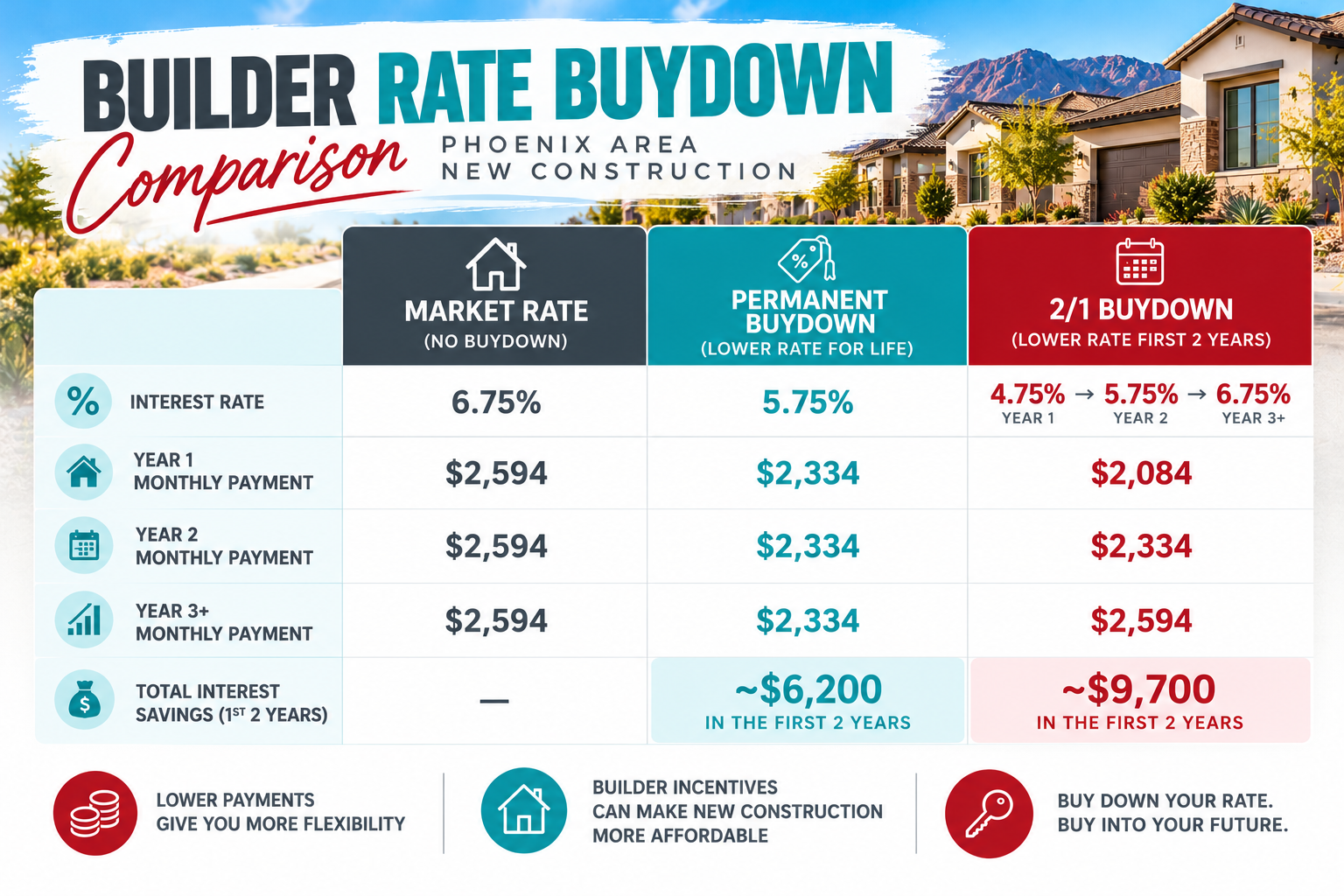
Spec Homes vs. Dirt Builds: Where the Leverage Actually Is
Maximizing a Q4 deal depends on targeting the right type of home.
A dirt build means selecting a lot and structural options, then waiting 6-9 months for construction. Builders rarely offer major concessions here, since they can't guarantee the home will close before their fiscal year-end.
A spec home (or Quick Move-In / QMI home) is one the builder is already constructing on its own dime — either fully finished or within 30-45 days of completion. This is where the builder is actively carrying inventory costs, and where real leverage for maximum incentives exists.
Three Rules for Negotiating With Builders
- Bring your own buyer's agent on visit #1. The friendly sales rep in the model home represents the builder's bottom line, not the buyer's. Some builders won't allow independent representation if an agent isn't registered on the first visit.
- Get an independent inspection — twice. Never assume a brand-new home is flawless. A pre-drywall inspection and a final pre-closing inspection from an independent inspector are both worth the cost.
- Negotiate lot premiums and design credits last. Secure the rate buydown credits first, then negotiate lot premium waivers, appliance packages, or window covering credits before signing.

Frequently Asked Questions
Why do homebuilders offer better deals at the end of the year? Public homebuilders face fiscal year-end and quarterly earnings pressure to move completed, unsold inventory off their books, which typically leads to stronger incentives — especially between October and December.
Will a builder just lower the home's list price if I ask? Usually not. Builders tend to protect published base prices to preserve comparative value for the rest of the community. Instead, they typically offer the equivalent value as flex cash or incentive credits.
What's the difference between a spec home and a dirt build? A spec home (Quick Move-In) is already built or nearly finished, giving the builder a strong incentive to close it quickly. A dirt build hasn't started construction yet and rarely comes with the same level of concessions.
Should I bring my own real estate agent to a new construction sales office? Yes, ideally on the first visit. The on-site sales representative works for the builder, and some builders require an agent to be registered on the initial visit to allow independent buyer representation.
Do new homes still need an inspection? Yes. A pre-drywall inspection and a final pre-closing inspection from an independent inspector help catch issues that can be present even in brand-new construction.
Want a Curated List of Current Q4 Incentives?
Builder incentives shift by community and by the week as fiscal deadlines approach. Reach out for a curated list of active quick move-in homes and current builder incentive packages across Gilbert, Chandler, Queen Creek, Surprise, and Peoria — buyer representation at no cost to you.

If you're weighing San Tan Valley new construction against a resale market like Chandler, our recent Chandler vs. San Tan Valley breakdown is a useful next read.
Katie Evans is a REALTOR® with the Living 48 Real Estate Team at REAL Broker, known across the Valley as The Real Estate Boss Mom. She serves buyers and sellers throughout the East Valley — Mesa, Gilbert, Chandler, Queen Creek, Tempe, and Scottsdale — with data-driven, straight-talking guidance.

Katie Evans
Lead Agent | Katie Evans | Living 48 Real Estate Team
or another way