
Categories
Real Estate Sellers, Arizona Buyers, Preparing Your House for SalePublished October 5, 2026
The Death of Cash Offers: How Phoenix Buyers Are Winning with Contingencies in 2026


If you own a home anywhere in Metro Phoenix — Gilbert, Chandler, North Scottsdale, Peoria, or beyond — and you've outgrown it, you're facing one of the most common real estate headaches: how do you buy your next home while selling your current one at the same time?
For the last few years, this felt nearly impossible. A home-sale contingency — "I'll buy your house as soon as mine sells" — got tossed out immediately in a market dominated by cash offers and multiple bids. Homeowners got stuck: stay in a home that no longer fits, or sell first, move into a rental, unpack twice, and shop under a ticking clock.
That era of cash-offer dominance is over in Metro Phoenix.
The Current Phoenix Market Reality
Local MLS data tells the story clearly: active inventory across Maricopa and Pinal counties is currently hovering above 23,000 listings, homes are averaging 60 to 75 days on market depending on the submarket, and roughly 75% of closed transactions are selling below their original list price.
What that means for a homeowner: seller leverage has normalized. Phoenix sellers can no longer demand cash-only, non-contingent buyers. They want serious, qualified buyers who can close — even if that means finalizing the sale of a current home first. Contingent offers, structured correctly, are getting accepted regularly right now.
Strategy 1: The Watertight Contingent Offer
A home-sale contingency, attached through an Arizona Association of Realtors Contingency Addendum, makes a new purchase contingent on the successful closing of the current home.
Where this typically falls apart: sellers won't accept a contingency if the buyer's current home isn't even listed yet. That's solved with a Pre-Market Prep Phase:
- Complete the prep work first. Photography, staging, inspection reports, and listing documents for the current home are finished before an offer goes in on the new home.
- Go live fast. The moment the offer is accepted on the new home, the current home goes live on the MLS within 24–48 hours.
- Set a firm window. A strict 14–21 day window to secure a contract on the current home keeps earnest money protected if it doesn't contract in time.
This turns a contingent offer from a red flag into something that looks — and functions — like a near-guaranteed deal to the seller on the other end.
Strategy 2: The Post-Closing Leaseback
For homeowners who don't want the stress of house-hunting while their current home is under contract, selling first with a leaseback solves the timing problem differently.
The current home is listed and sold first, but instead of moving out on closing day, a 30–60 day leaseback (Post-Closing Occupancy Agreement) is negotiated directly into the purchase contract.
The advantages:
- Full proceeds land immediately. Cash from the sale is deposited on Day 1.
- Contingent-offer risk disappears. Shopping for the next home happens as a firm, non-contingent buyer with cash in hand.
- Only one move. Keys to the old home change hands the same day the new home is ready to move into.
Strategy 3: Bridge Loans and Mortgage Recasting
For homeowners who want to buy the new home before ever listing the current one, two financing tools make that possible when there's meaningful equity built up:
Bridge Loan — A short-term loan that taps into current home equity to fund the down payment on the new home. This allows a purchase and move first, with the vacant, staged former home then listed for top dollar without time pressure.
Mortgage Recasting — The new home is purchased with a smaller down payment (5–10%), and once the old home sells shortly after, the equity lump sum ($150,000–$200,000, for example) is applied directly to the new loan's principal. For a modest administrative fee — typically $250–$500 — the lender recalculates the monthly payment at the new, lower balance, without requiring a full refinance or a new interest rate.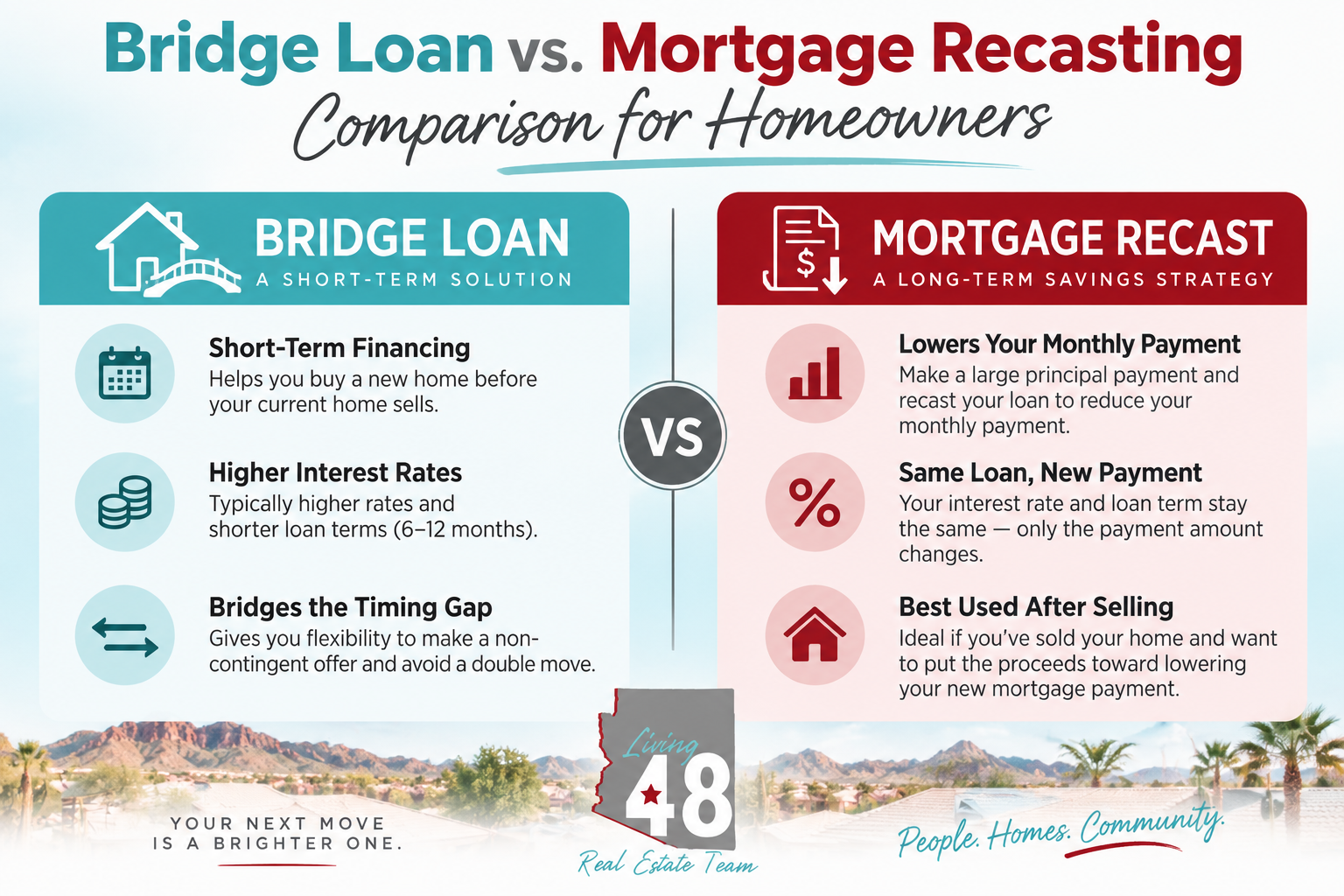
Coordinating a Same-Day Closing
When both sales close on the same day through an Arizona title company, timing has to be exact. Arizona is a "dry closing" state — funds must be wire-verified and documents recorded at the County Recorder's office (Maricopa or Pinal) before keys change hands. A typical 48-hour sequence looks like:
- Day 1, 8:00 AM — Buyer of the current home wires funds to Title Company A
- Day 1, 12:00 PM — Title Company A records the deed and transfers net equity to Title Company B (handling the new home)
- Day 2, 9:00 AM — Title Company B records the deed for the new home
- Day 2, 11:00 AM — Keys to the new home are handed over and the move begins
Managing that sequence correctly is what prevents a homeowner from ever carrying two mortgages or facing a housing gap in between.
Frequently Asked Questions
Can I buy a new home before selling my current one in Phoenix right now? Yes. With inventory above 23,000 listings and roughly 75% of homes closing below list price, sellers are more open to contingent offers than they were during the peak seller's market, especially when the contingency is structured with a pre-market prep phase.
What is a home-sale contingency? A contract clause stating that a buyer's purchase of a new home depends on the successful closing of their current home, typically attached through an Arizona Association of Realtors Contingency Addendum.
What is a seller leaseback agreement? An arrangement where a seller closes on the sale of their home but continues living in it for an agreed period (often 30–60 days) as a tenant of the new owner, allowing a single move instead of two.
Should I use a bridge loan or mortgage recasting to buy before I sell? A bridge loan provides upfront funds by borrowing against current home equity, useful for buying and moving first. Mortgage recasting allows a smaller initial down payment, followed by a lump-sum principal reduction once the old home sells, lowering the monthly payment without a full refinance.
Why does closing timing matter so much in Arizona? Arizona is a "dry closing" state, meaning funds must be wire-verified and deeds recorded with the county before keys are released — making precise 48-hour coordination between title companies essential for a same-day, single-move closing.
Download the Full Strategy Blueprint
This covers the core pillars, but every homeowner's equity position and timeline are different. Download the free Simultaneous Buy & Sell Strategy Blueprint to map out your specific numbers, or book a strategy call and my team will walk you through exactly which approach fits your situation.

For homeowners planning ahead of a move, our recent piece on maintenance blindspots that quietly drain equity is worth a look before listing.
Katie Evans is a REALTOR® with the Living 48 Real Estate Team at REAL Broker, known across the Valley as The Real Estate Boss Mom. She serves buyers and sellers throughout the East Valley — Mesa, Gilbert, Chandler, Queen Creek, Tempe, and Scottsdale — with data-driven, straight-talking guidance.

Katie Evans
Lead Agent | Katie Evans | Living 48 Real Estate Team
or another way