
Published July 27, 2026
Is Now a Good Time to Buy a House in Phoenix, Arizona? What the July 2026 Data Actually Says


Is Now a Good Time to Buy a House in Phoenix, Arizona? What the July 2026 Data Actually Says
If you ask ten different Phoenix-area real estate agents whether now is a good time to buy, I'll bet all ten say yes. Most will hand you some version of a line you've heard a hundred times before and call it advice.
You deserve better than a slogan. You deserve the numbers.
So let's actually look at what's happening in the Arizona real estate market in July 2026 — because the data is telling a story that a lot of buyers are missing, and missing it is costing them money.
What Is the Cromford Index, and Why Should Arizona Buyers Actually Care?
If you want to understand the Phoenix housing market, there's one number that matters more than any headline: the Cromford Index.
It's produced by the Cromford Report, and it's widely considered the gold standard for tracking supply, demand, and pricing pressure across Arizona. Tina Tambor, a senior housing analyst here in Arizona, works with the Cromford Report and regularly breaks down what these numbers mean for brokerages and agents across the Valley.
Here's the short version:
- 100 = a perfectly balanced market. Neither buyers nor sellers have the advantage.
- Above 100 = a seller's market. Think 2021-2022 — waived inspections, bidding wars, frenzy.
- Below 100 = a buyer's market. Leverage shifts to you.
Right now, the statewide Cromford Index is sitting right around 80. Tina Tambor has called this one of the best buyer opportunities Arizona has seen in years.
The Cromford Index Is at 80. Here's What That Actually Means for Your Wallet
An index score of 80 tells us demand is being suppressed — mostly by interest rates hovering in the 6.5%–6.6% range, not by a lack of buyer interest.
A lot of people have been sitting on the fence, waiting for prices to crash the way they did in 2008. Here's the reality: that hasn't happened, and the data doesn't support it happening now.
- The median home price across the Valley has held steady around $450,000 for several years.
- Inventory is tightly metered — not overflowing, but not scarce either.
- There's no foreclosure wave and no oversupply driving prices down.
Translation: the Phoenix market isn't collapsing. It's stable. And a stable market with softened demand is exactly where buyers get real leverage — without the risk of buying into a falling market.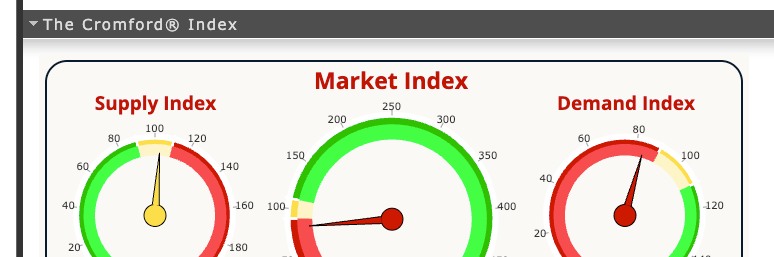
Not Every City Plays by the Same Rules
Here's the caveat that matters: the Cromford Index of 80 is a statewide number. Individual cities — even individual zip codes — move differently.
Broadly speaking, the Phoenix Metro splits into a few distinct zones:
- West Valley
- East Valley — Gilbert, Chandler, Tempe, Mesa, Apache Junction, Queen Creek, San Tan Valley
- Northeast Valley — largely luxury inventory
Buyer leverage right now is strongest in mid-tier single-family homes under $500,000 in growth corridors like Queen Creek and San Tan Valley. Meanwhile, core East Valley cities — Tempe, Mesa, and Chandler — are holding their values more tightly and trending closer to balanced or even seller-favored conditions.
The point: your strategy has to match your zip code, not the statewide headline. This is exactly why working with an agent who tracks hyperlocal data — not just national trends — matters.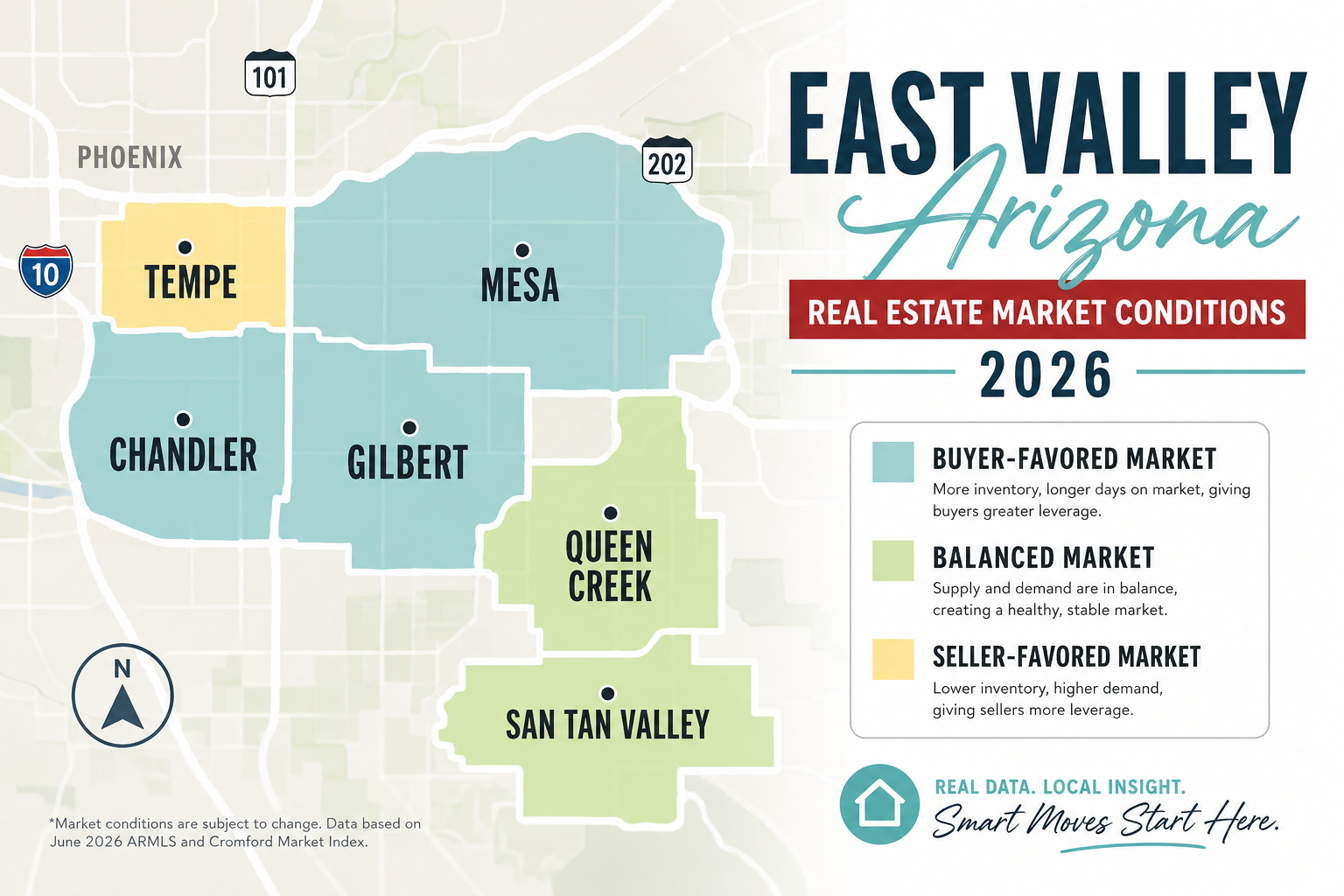
The Real Opportunity: Sellers Are Paying You to Buy
This is the part most buyers overlook, because it doesn't show up in the headline price.
Across Maricopa County, more than 54% of single-family home sales now include active seller concessions, averaging over $10,000 in credits. Average days on market has stretched to 40–55 days, giving sellers real incentive to negotiate rather than wait.
Sellers are readily covering:
- Buyer closing costs
- Interest rate buy-downs
On top of that, an index score of 80 buys you something you haven't had in years: time.
- Time to go back for a second showing
- Time to think it over
- Time to compare properties and review utility efficiency
- Room to negotiate real inspection terms — without the fear that the home is about to slip away
Note: this doesn't apply everywhere. Some pockets of the East Valley are still moving fast, multiple-offer style. That's why local guidance matters more than a national headline.
What Happens When Rates Finally Drop?
Buyers waiting for mortgage rates to fall into the 5% range should know what's happened every other time that's occurred: demand floods back into the Valley almost instantly.
When demand rises faster than inventory, the Cromford Index climbs back above 100 — and pricing power shifts right back to sellers. History suggests that when that happens, home values move up with it.
In other words: the leverage buyers have today, at a rate near 6.5%, is very likely temporary. Locking in a purchase price now — while negotiating power still belongs to you — may matter more than the rate itself.
So — Is Now a Good Time to Buy in Phoenix?
The honest answer: yes, with a caveat.
Yes, if you understand how to leverage an index score of 80. Yes, if your agent is adjusting strategy city by city, not applying a one-size-fits-all approach. But if you walk into a purchase expecting 2022 rules — rushed timelines, waived contingencies, bidding wars — you'll misjudge the market entirely.
Walk in with a real strategy, and you can secure a stable asset, often below market value, with the seller helping buy down your rate.
Frequently Asked Questions: Phoenix Housing Market, July 2026
Is the Phoenix real estate market a buyer's market right now? Yes. As of July 2026, the statewide Cromford Index sits at approximately 80, which indicates market conditions favoring buyers. This varies by city and zip code.
What is the Cromford Index? The Cromford Index is a data model tracking supply and demand in the Arizona real estate market. A score of 100 represents a balanced market; below 100 favors buyers, above 100 favors sellers.
Are home prices dropping in Phoenix, Arizona? No. The median home price across the Valley has held steady around $450,000 for several years. Instead of falling prices, buyers are seeing increased seller concessions and longer negotiating windows.
What are seller concessions, and how common are they in Maricopa County? Seller concessions are credits a seller offers a buyer, typically toward closing costs or an interest rate buy-down. Over 54% of Maricopa County single-family sales currently include them, averaging more than $10,000.
Is every East Valley city a buyer's market? No. Growth corridors like Queen Creek and San Tan Valley currently favor buyers more strongly. Core cities like Tempe, Mesa, and Chandler are holding tighter and trending closer to balanced conditions.
Want the Full Numbers?
I put together the July 2026 Phoenix Market Truth Sheet — it breaks down exactly how the Cromford Index affects your buying power city by city, and what to ask for in today's negotiations. Grab it below.

Katie Evans is a REALTOR® with the Living 48 Real Estate Team at REAL Broker, known across the Valley as The Real Estate Boss Mom. She serves buyers and sellers throughout the East Valley — Mesa, Gilbert, Chandler, Queen Creek, Tempe, and Scottsdale — with data-driven, straight-talking guidance.